Medical intelligence has been scarce for as long as it has existed. Patients waited weeks for care, scheduled around it, and got a few minutes of it at a time. AI made medical intelligence abundant. Care is still scarce.
Forty million people now ask ChatGPT about their health every day. One in four of ChatGPT's 800 million weekly users prompts about healthcare every week.1 People ask about symptoms, labs, medications, and next steps before they ask their doctor, and the answer arrives instantly. The second you need AI to take action for you, it hits a wall.
AI can explain the lab result, draft the questions for your next doctor's appointment, and suggest what steps need to be taken next. But it cannot send the referral, fill the prescription, or update your doctor on how your new meds are impacting you.
We're experiencing a collision in healthcare: abundant intelligence on one side, a fragmented healthcare system on the other, with the patient stuck in the middle.
For the last twenty years, healthcare's answer to digital access was the portal. One for the doctor, lab, insurance, and the pharmacy. Portals gave patients more places to log in, scattered data, and gave them the job of managing it all themselves. It certainly did not give them more agency.
The next interface is different and it's already here. The primary consumer of healthcare is shifting from the patient to their agent, and this shift requires new infrastructure.
Why the current system breaks
1. Agents don't have context
We've spent the last five years at Flexpa working on one problem: getting patients their own health data. So when we talk about agents hitting a wall, we can tell you exactly what the wall is made of.
Healthcare runs on context. Diagnoses, meds, allergies, labs, coverage, what happened after the last visit. Give a doctor more of that picture and you get a faster, better call. Same for an agent.
The data exists. It's just scattered. Your insurer has the claims. Your doctor's EHR has the notes. The lab, the pharmacy, and the last three portals you forgot the passwords to each hold a piece. Nobody in that chain gets paid to hand your agent the full picture.
So the patient fills the gap by hand. Repeat your history from memory. Upload the PDF. Call for records. This is the clipboard, digitized. At Flexpa we've seen a single patient's history run past 100,000 records. Nobody carries that in their head, and no agent should have to guess at it.
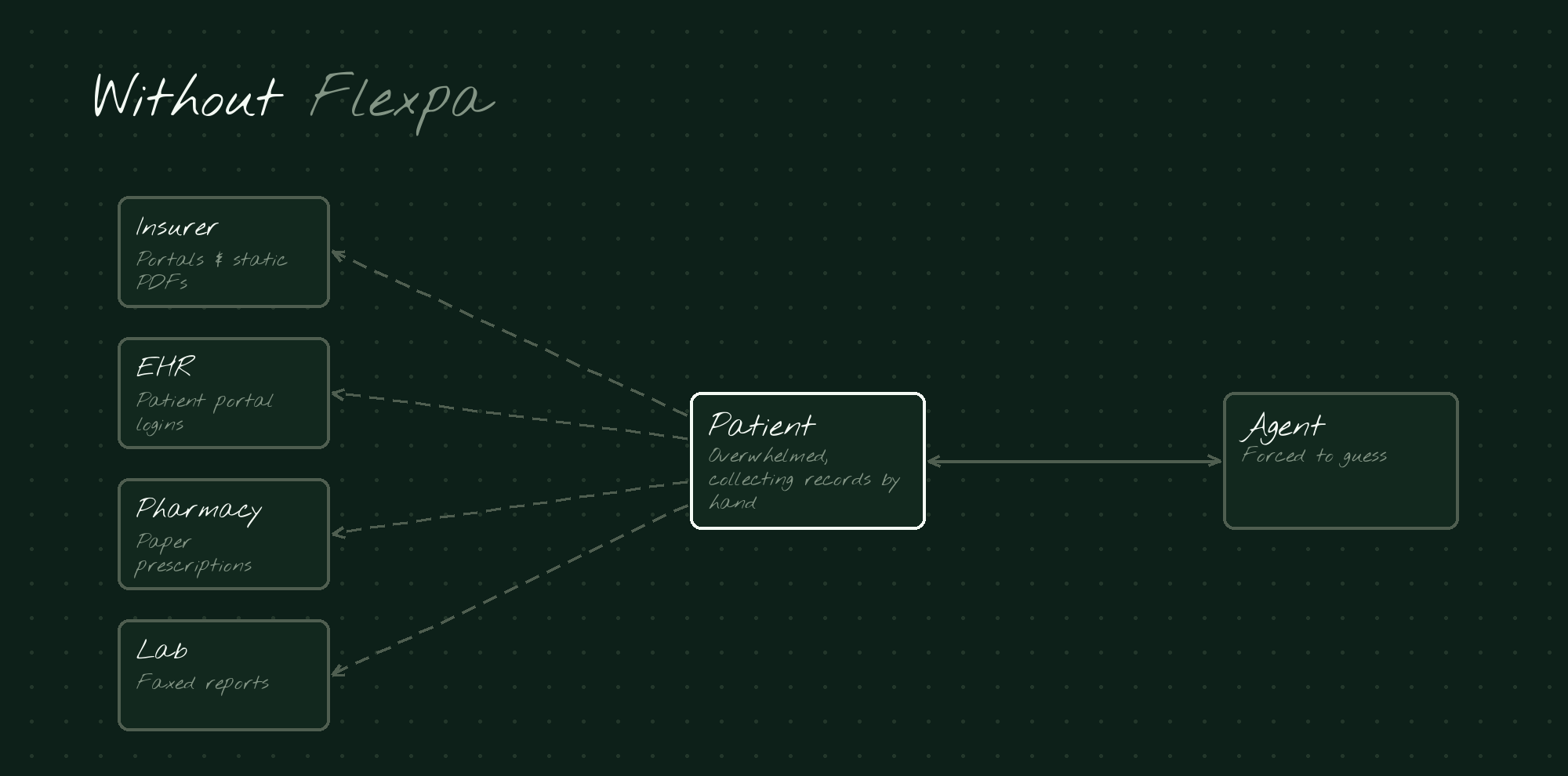
That's why health AI still feels generic in the one domain that has to be personal. The agent can explain a medication. It can't tell you what that medication means next to your kidney function, your allergy list, and the prescription you stopped filling in March.
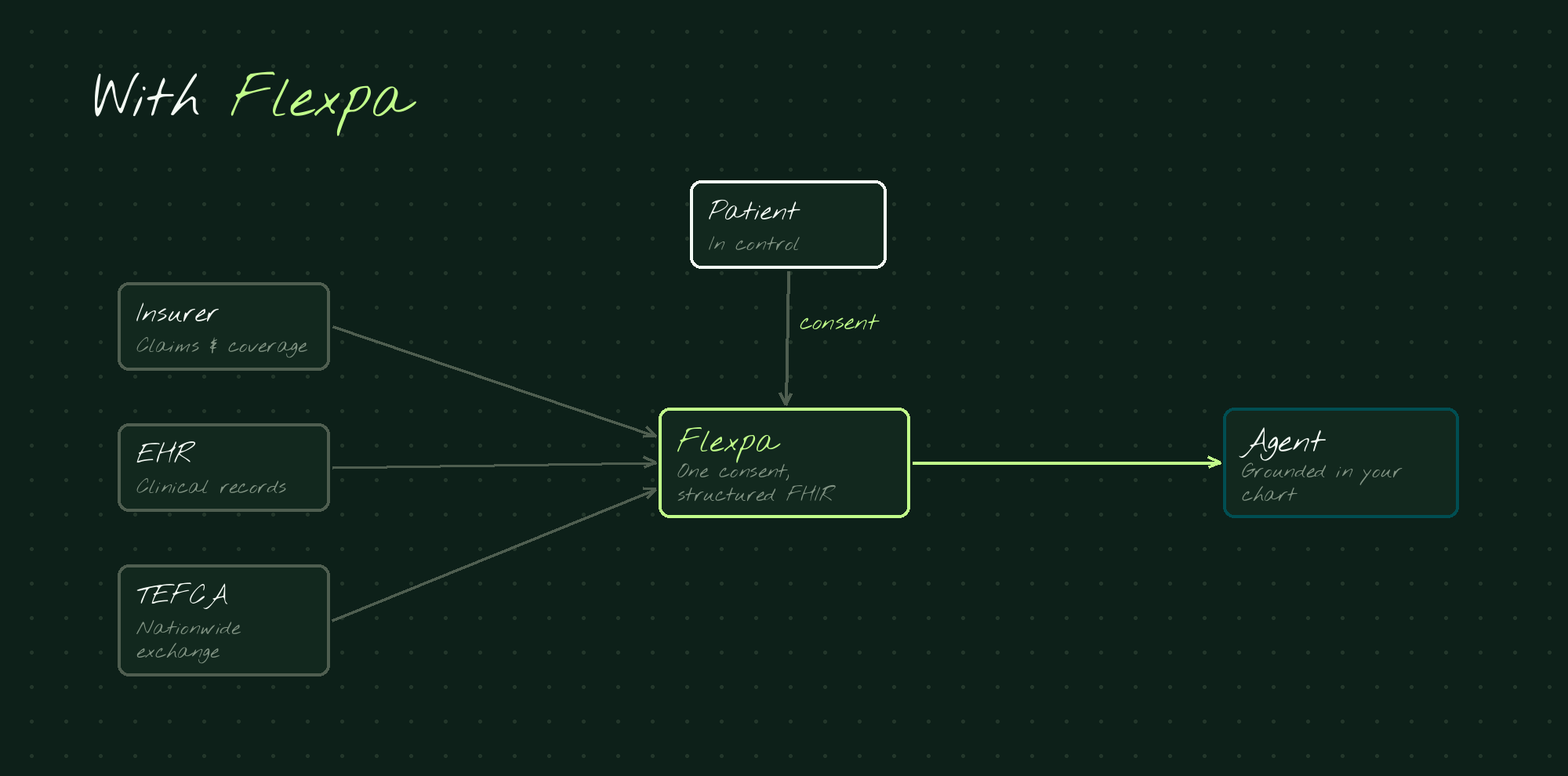
The good news: the rails to fix this already exist, and they're federal. Patients have a legal right of access to their own records. CMS-9115 requires insurers to expose claims and coverage through APIs. ONC (g)(10) does the same for medical record systems. TEFCA connects records nationwide. Flexpa is where we tie all three networks together: the patient verifies their identity, consents, and their agent gets their real history as structured FHIR data, in seconds. Consent stays with the patient and is revocable any time. One more thing makes the picture whole: claims. Flexpa connects your payer claims alongside your clinical records, so your agent sees your health and your spend.
Our homepage says it in four words: health records for agents. It's the difference between an agent that reads the textbook and an agent that reads your chart. This already works in production: Oura grounds its AI health insights in members' real clinical records through Flexpa. Arlo is one of the teams building on exactly this, which is what the rest of this post is about.
2. Agents can't act
Acting in healthcare today requires a licensed clinician. A licensed clinician has to review and sign a prescription, then send it to a pharmacy. A lab order goes through the right system, gets done, and comes back to the correct provider to interpret and update the patient. A referral has to reach a specialist with the right records and coverage. Even a coverage check needs access to payer systems and the patient's benefits.
Agents can't do any of this on their own. They aren't licensed, can't carry clinical liability, and can't prescribe or order. They also lack the identity, consent, credentials, and integrations needed to work with EHRs, pharmacies, labs, specialists, and insurers.
The healthcare system has no standard way to take a message from an agent and start a clinical action. So even when an agent finds the right next step, it can't take it. AI can say "you may need this medication," but it can't talk to a doctor and get the prescription.
Today the patient is the execution layer. They leave the chat, find a provider, book an appointment, repeat their history, get the order, coordinate the pharmacy or lab, and chase the follow-up.
The agent provides the intelligence; the patient carries it through the system by hand. That's the hard stop between advice and care. Agents can work out what should happen next. They can't make it happen.
What can be unlocked
1. The data rails
The first requirement is a reliable way for the patient to give an agent access to their health history.
With permission, the agent can retrieve claims, coverage, medications, labs, records, and clinical history from the systems that already hold them. The patient remains in control of access; the agent becomes the working surface for using the information.
This replaces manual reconstruction with usable context. The agent can understand what has already happened, avoid asking the patient to repeat it, and pass a cleaner picture into the next step of care.
This layer is Flexpa. Consented access across insurers, medical record systems, and nationwide exchanges, delivered to the agent as structured FHIR data.
2. A licensed execution layer
Patients want their personal agent to turn information and a decision into real care. This action layer makes that possible. It verifies who the patient is, gets their consent, brings the right context into the consult, and pulls in a licensed clinician when medical judgment is needed.
It should work as a router, not another app or closed clinic. It connects the agent to the care the patient already has: their doctor, pharmacy, insurer, labs, and records. When the patient needs care now, it routes to an available clinician. When continuity matters, it works through the patient's existing doctor. The goal is a reliable path through the system.
This action layer is Arlo. Today, an agent can get a real prescription from a licensed doctor in minutes. Add our MCP and it works. We're building Arlo to grow to labs, referrals, records, and coverage, and from our own clinical network to the patient's existing providers.
Flexpa gives the agent the patient's context. Arlo turns that context into licensed action. Together they form the base for an agent that knows the patient over years, acts inside the healthcare system they already have, and carries each result into the next decision.
3. Long-horizon agents
Healthcare is organized around visits. Each appointment starts with a partial history, treats the immediate problem, and ends with the patient responsible for remembering what happened and doing the follow-up. No one carries the thread across providers, systems, and time.
Agents can work differently. A long-horizon agent stays with the patient between visits. It remembers the medication change, the abnormal lab, the recurring symptom, the referral that never happened, and whether the treatment worked. It doesn't treat each interaction as a new episode.
Say a patient gets side effects after starting a new medication. Today their agent can explain what might be happening, then tells them to call their doctor. The patient leaves the conversation, books an appointment, repeats when the medication started and what changed, waits for a clinician, coordinates the new prescription with the pharmacy, and manages the follow-up alone.
A long-horizon agent would already know the start date, the dose, the history, and why it was prescribed. With permission, it could bring that context to a licensed clinician, route the new prescription to the pharmacy, and check back a few days later to see whether the change worked. That result becomes context for the next decision.
This doesn't replace the doctor. The patient controls permission, the clinician owns medical judgment, and the agent carries the context and coordinates what happens next.
Data access and execution compound. Better context makes better decisions, action produces new information, and that information improves the next decision. Over time the agent catches missed follow-ups, watches for changes, hands clinicians a fuller history, and surfaces care before a small problem grows into a big one.
The opportunity is a healthcare relationship that lasts. Healthcare shifts from disconnected visits to continuous care organized around the person.
Where this leads
Patients now have their first healthcare conversation with AI, because AI is there when they need it. The infrastructure that lets that conversation act has not caught up.
The next interface won't be another portal or an app the patient opens twice a year. Healthcare will become a capability inside the agent the patient already uses, and that agent will do more than explain healthcare — it will help deliver it.
The front door has moved, and the next billion consults will happen through agents. The future of healthcare is patient to agent.
This is the first post in a four-part series from Arlo and Flexpa. Next: what patient to agent looks like today, in production. Then: how consent and identity work when an agent acts for you. Last: agents that act instead of just read. If you think we're wrong about any of it, we want to hear why.
Footnotes
-
OpenAI, OpenAI and Healthcare: The Path to Personalized, Accessible Care for All (2026). Figures reported as of early 2026; 40 million daily health queries and 800 million weekly active users are OpenAI's own disclosures. ↩