One last time, return to the patient whose agent recommended another lab test.
In part 2, that story stopped cold. The agent read the result, asked the right follow-ups, suggested the next test, and then handed everything back to the patient: find a provider, book the appointment, repeat your history, chase the follow-up. Smart advice, and then a to-do list.
Now run the same story with the pieces connected. The agent already has the chart, claims and clinical data, because the patient consented once and can revoke whenever they want. It checks coverage, finds an in-network draw site, and books an appointment Thursday morning. A licensed clinician reviews the case with the full picture and signs the order. The sample gets drawn. The result lands back in the patient's record, the agent reads it, flags the change, and books the follow-up. The patient did two things in this whole story. They said yes at the start, and they showed up Thursday.
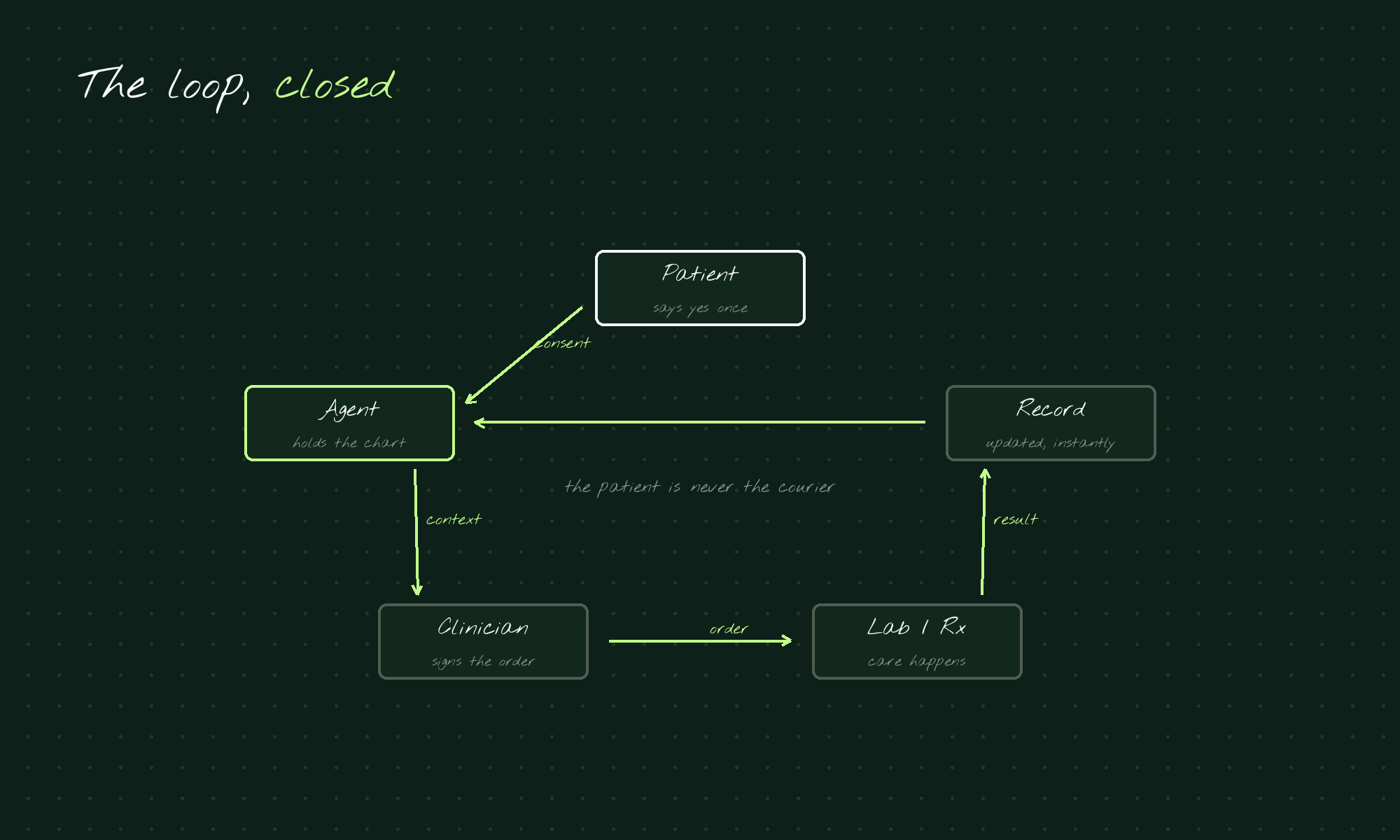
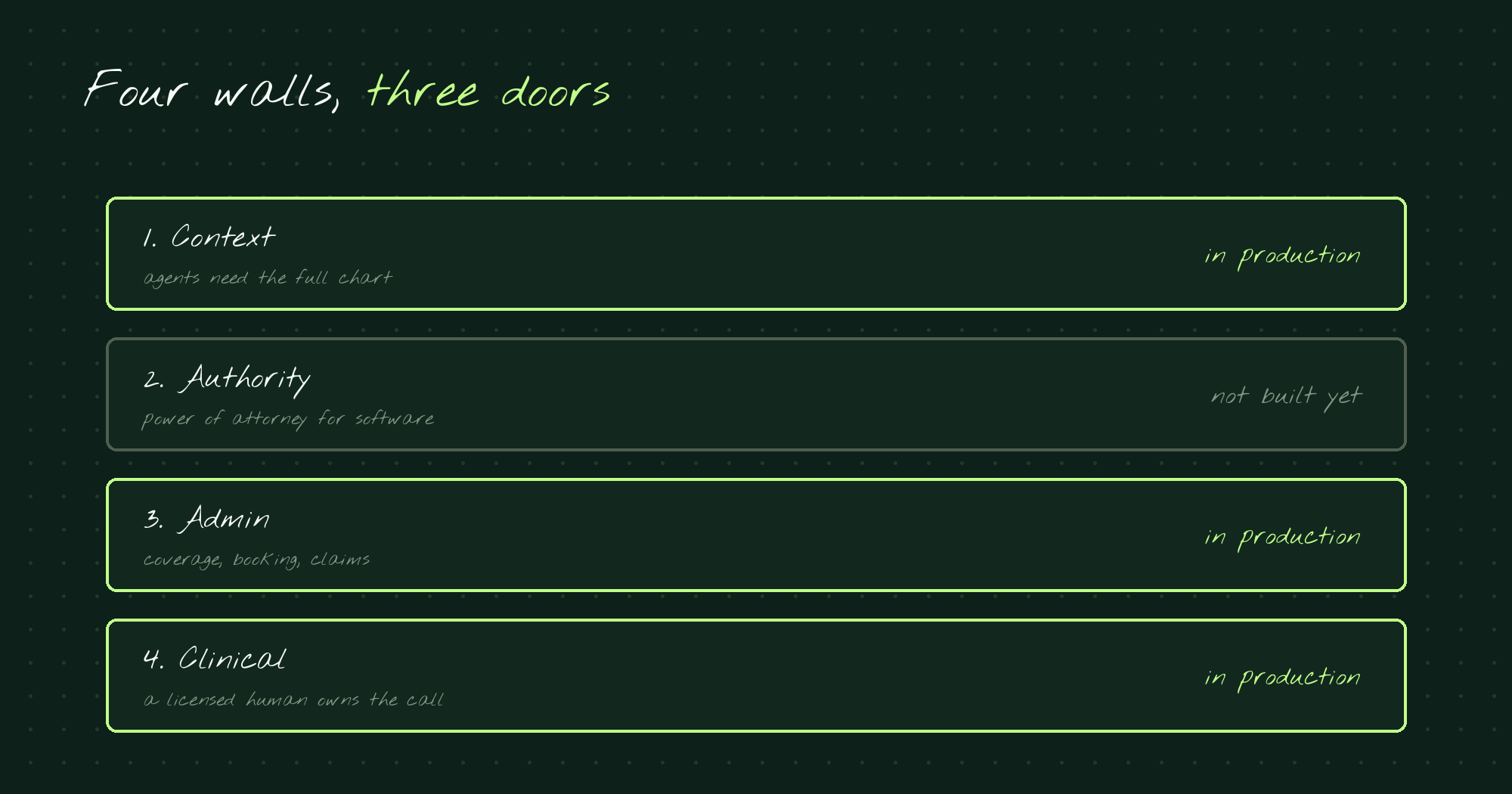
That's the loop, closed. And almost none of it is hypothetical. The context layer runs in production today; agents pull real histories as structured FHIR in seconds, and companies like Oura already ground their AI in it. The execution layer runs in production today; through Arlo, an agent can get a prescription from a licensed clinician in minutes. Verified consent runs in production today, on federal identity standards. We named four walls in part 2. Three of them have doors now.
What the loop changes
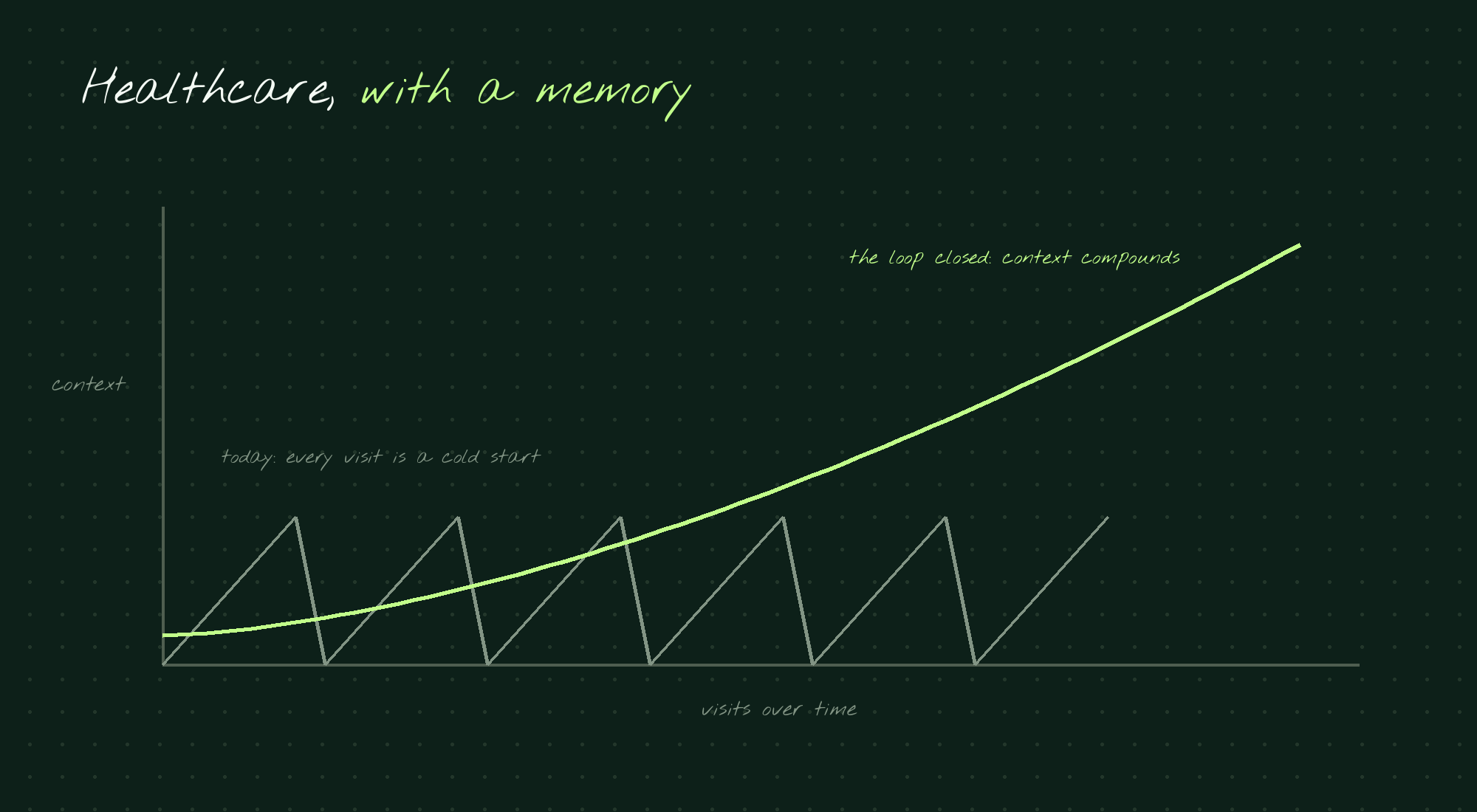
Healthcare has no memory. Each appointment starts with a partial history and ends with the patient responsible for remembering what happened. Every visit is a cold start. Ask anyone who has managed a sick parent's care what the hardest part was. It's never the medicine. It's re-explaining everything, to everyone, forever.
A closed loop ends the cold starts. Every completed action writes a new fact into the record: the order, the result, the prescription, whether the treatment actually worked. The rails carry that fact back to the agent, and the agent carries it into the next decision. Better context, better decisions. More actions, more context. It compounds, which is exactly what the current fragmented system can't do.
This is where the whole series comes together. Part 1 said AI made medical intelligence abundant while care stayed scarce. The loop is how abundance actually reaches care. An agent that remembers, acts, and learns from each action takes over the coordination work that eats clinician hours and patient weeks today. Clinicians spend their judgment on judgment. Patients spend their time getting better. Care stops being a pile of disconnected episodes and starts being a relationship.
What's still missing
Two things.
The first is the authority standard, the wall we spent all of part 3 on. There is still no power of attorney for software. Right now every connection between an agent and the system it acts on is a bilateral deal, negotiated one relationship at a time. That works, and it's how every network in history got started. But the loop doesn't reach every patient until a provider anywhere can take a request from an agent it has never met, checked against a common standard: who authorized this, what can it do, when does the permission expire, who is accountable if it misbehaves. The identity half already exists in federal frameworks. The delegation half is a spec nobody has written. If you work at a standards body, a network, or a regulator and this paragraph annoyed you, good. Come write it with us.
The second is the write path. Today the rails run one direction: read. Results come back to the patient's record the long way, through the clinician's systems, so the loop closes at the speed of the slowest fax machine in the chain. The last mile is a record that updates as fast as the action happened. Nobody has built that at scale yet. Somebody will.
Neither of these is new science. Nothing in this series needed a smarter model or a breakthrough. The loop is plumbing and permission, and both of those are choices.
Where this leads
Four posts ago we described a collision: abundant intelligence on one side, a fragmented healthcare system on the other, and the patient stuck in the middle. Part 1 named the collision. Part 2 sorted the work and named the walls. Part 3 argued that agents are the first thing to make consent real. This one names the prize: care that starts in a conversation, finishes inside the healthcare system, and leaves the patient's record smarter than it found it.
If you're building agents: the rails are live. Wire in.
If you're a payer or a provider: a verified, consented, accountable agent is a better counterparty than a fax machine, and the first organizations to treat it that way get to set the defaults everyone else inherits.
If you write the rules: the delegation standard is the most useful document in healthcare that doesn't exist yet.
We started this series with a patient stuck in the middle. We're ending it with the patient at the center. Those sound similar. They're opposites.
The front door has moved. The next billion consults will happen through agents, and for the first time, healthcare will remember what happened last time.
The future of healthcare is patient to agent. It's time to let agents act in healthcare. Let's go build it.
This is the final post in a four-part series from Arlo and Flexpa. Catch up: Part 1: Stuck in the Middle, Part 2: Time to Act, Part 3: Consent Theater. We said at the start that if you think we're wrong, we want to hear why. That offer doesn't expire with the series.